


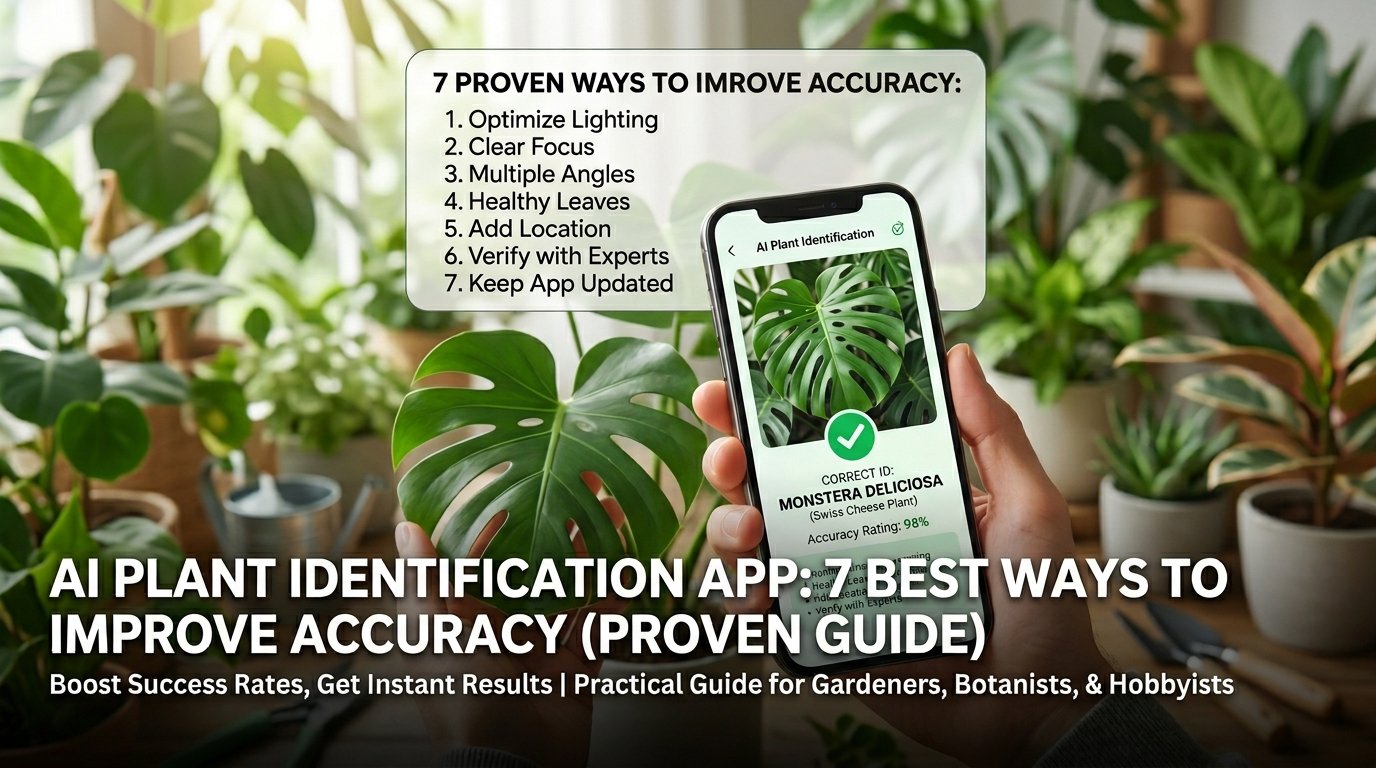
Every AI plant identification app promises instant, accurate results—but real-world testing tells a different story. Accuracy rates range from 40% to 78% depending on the app, misidentification is common, and hidden subscription costs frustrate millions of users. This guide covers how these apps actually work, which ones perform best, and how to avoid the most common mistakes before you trust an AI with your garden.
Table of Contents
5 Best AI Plant Identification Apps Tested – Accuracy, Cost, and Real Results in 2025
The AI plant identification app market hit USD 450 million in 2024 and is growing fast—but download numbers and star ratings do not tell you what actually matters: how often the app gets it right. After reviewing published accuracy tests and user data across six major apps, this guide gives you the real numbers and a clear framework for choosing and using these tools without falling into the most common traps.
What Is an AI Plant Identification App?
An AI plant identification app uses image recognition and machine learning to match a photo of a plant to species in its database. You photograph a leaf, flower, or fruit, upload it to the app, and within seconds it returns a species name along with care information, toxicity warnings, or disease diagnoses depending on the app.
These apps have become popular tools for home gardeners, hikers, botanists, and anyone who encounters an unfamiliar plant. The best ones can correctly identify common species from a single clear photo in under 3 seconds. The worst routinely confuse species that look similar to untrained eyes—and occasionally confuse edible plants with toxic lookalikes, which is the most serious risk of over-relying on these tools.
The technology works best with clear, well-lit photos of distinctive plant features—flowers and fruit produce more accurate results than plain green leaves, which look similar across hundreds of species.
How to Use an AI Plant Identification App Correctly
Most people who get poor results from an AI plant identification app are making one of three avoidable mistakes: photographing the wrong plant feature, using a blurry or poorly lit image, or trusting a single result without cross-checking. Here is the process that produces consistently better results:
- Choose your photo subject carefully. Flowers and fruit are the most distinctive features—photograph these whenever possible. Plain green leaves produce the most errors. If the plant has no flowers or fruit, photograph multiple leaf angles including the underside.
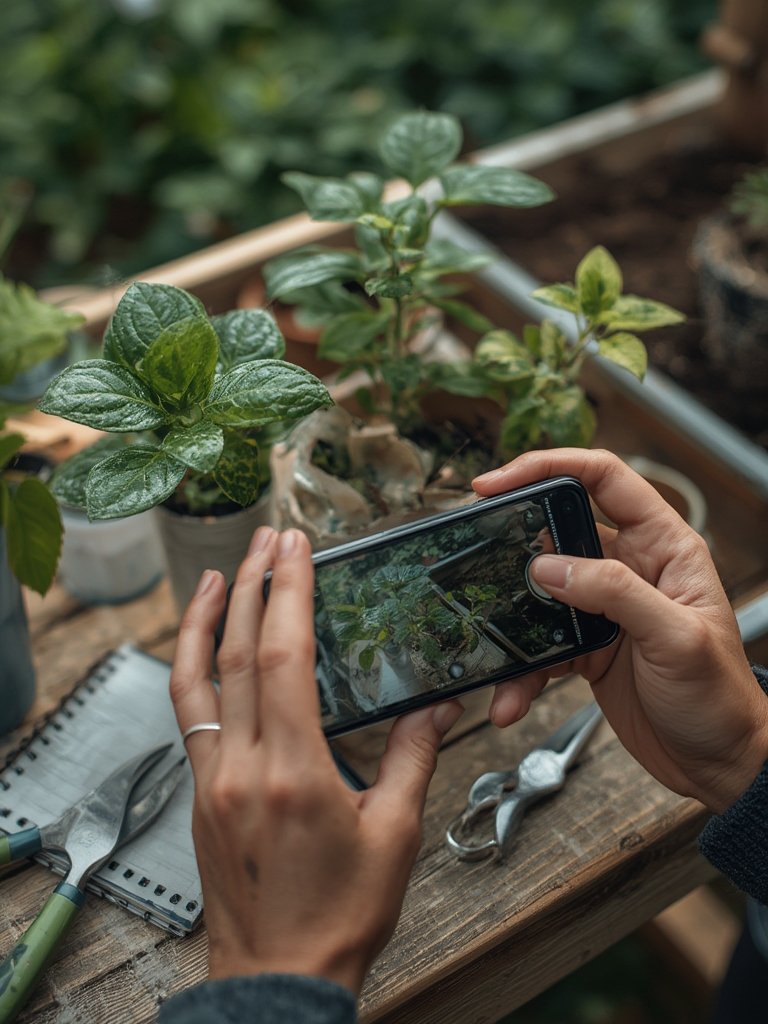
- Optimize your photo conditions. Natural daylight produces the best results. Avoid shadows across the subject and ensure the plant is in focus with a plain or blurred background. Move clutter out of frame before shooting.
- Upload multiple photos per identification. Most apps accept multiple images per query. Uploading 2–3 photos of different features (leaf, stem, flower) measurably improves accuracy, especially for species with distinctive multi-feature combinations.
- Review confidence scores critically. Quality apps show a confidence percentage alongside each result. Results below 70% confidence should be treated as a starting point for further research, not a confirmed identification.
- Cross-check every result you plan to act on. Paste the suggested species name into Google Images and compare with verified photos from botanical databases like the USDA Plants Database or Plants of the World Online. This step takes 60 seconds and eliminates most consequential misidentification errors.
- Never use app results alone for edibility or toxicity decisions. No AI plant identification app currently meets the accuracy standard required for confirming a plant is safe to eat. Always consult a local expert, field guide, or botanical authority before consuming any foraged plant.
Pro tip: If you regularly identify plants in a specific region, apps that allow you to set a geographic filter (PlantNet does this well) return more regionally relevant results and fewer false positives from species that do not grow in your area.
AI Plant Identification App Accuracy: Real Test Results
Published accuracy data for AI plant identification apps is surprisingly rare—most apps do not voluntarily publish error rates. The most comprehensive publicly available comparison comes from independent testing at Growit Buildit, which tested six major apps against a standardized set of plant images. Here are the results:
| App | Accuracy Rate | Error Rate | Downloads / Rating |
|---|---|---|---|
| PictureThis | 78% | 21% | 50M / 4.6 ⭐ |
| PlantNet | 68% | 32% | 10M / 4.4 ⭐ |
| PlantAPP | 57% | 43% | N/A |
| Google Lens | 48% | 36% | Pre-installed |
| Blossom | 40% | 52% | 5M / 4.6 ⭐ |
| Plant Story | 44% | 56% | N/A |
The headline finding is that even the best-performing AI plant identification app on this list—PictureThis at 78%—gets it wrong roughly one time in five. Blossom and Plant Story fail on more than half of identifications despite strong star ratings, which illustrates why user reviews are a poor proxy for actual accuracy.
Star ratings reflect user experience and interface quality as much as identification accuracy. Users often rate apps highly when they feel helpful and engaging, even if the underlying identification results are frequently wrong. Treat accuracy statistics from independent testing as far more reliable than app store ratings when choosing a tool for serious plant identification work.
5 Common Problems with AI Plant ID Apps
Beyond accuracy rates, users consistently encounter the same five problems with any AI plant identification app. Understanding them in advance prevents the most common frustrations:
1. Overconfident results on difficult identifications. Apps frequently return high-confidence results for identifications that are actually uncertain. A result showing “95% confidence” for a rare regional cultivar should be treated with the same skepticism as a 55% result—the confidence score reflects the model’s internal certainty, not real-world accuracy.
2. Unreliable disease and pest diagnosis. Most apps offer disease diagnosis features, but no reputable independent accuracy benchmarks exist for this function. Disease identification from photos is significantly harder than species identification—many diseases produce visually similar symptoms across different pathogens. Use app disease suggestions as a starting hypothesis and confirm with your local agricultural extension service before treating.
3. Non-transparent subscription pricing. Most apps offer limited free identifications before requiring a subscription. Pricing is rarely clear in app store listings, and annual subscription costs typically range from $20–$50. Always check the full subscription terms before providing payment information.
4. Vague data privacy policies. Apps that you photograph plants with also collect your location data, device information, and the images themselves. Few apps publish clear policies on how long images are retained, whether they are used to train future models, or whether they are shared with third parties. If you are photographing rare specimens, private property, or commercially sensitive plants, review the app’s privacy policy before uploading.
5. Poor coverage of rare and regional species. Apps perform best on common, well-documented species with large training datasets. Rare species, regional cultivars, hybrids, and plants in unusual growing conditions produce the highest error rates. If you regularly work with uncommon plants, supplement any AI tool with regional field guides and local botanical society resources.
Which AI Plant Identification App Should You Choose?
Based on the accuracy data and feature set, here is how to match an AI plant identification app to your specific use case:
For highest accuracy on common species: PictureThis at 78% is the clear leader in published testing. Its interface is polished, the care information database is extensive, and it handles common garden plants, houseplants, and wildflowers well. The subscription cost ($29.99/year) is the main drawback.
For free, science-backed identification: PlantNet is a citizen science project developed by French research institutions and is completely free. At 68% accuracy it performs meaningfully better than Google Lens, and its geographic filter system makes it particularly strong for regional plant identification. It lacks the polished UI and care advice of paid apps, but for accuracy without cost it is the best option.
For casual use alongside other Google tools: Google Lens at 48% accuracy is convenient because it requires no separate app, but its identification rate is significantly lower than dedicated plant ID tools. It is adequate for identifying common ornamental plants where a rough identification is sufficient, but not reliable enough for botanical, edibility, or invasive species work.
For apps to avoid: Blossom and Plant Story both have error rates above 50% in independent testing. Their high star ratings reflect good user experience design rather than accurate identification. Neither is suitable for any use case where correct identification matters.
How AI Plant ID Apps Fit into a Smart Garden Setup
An AI plant identification app is most valuable when it is one component of a broader smart gardening approach rather than a standalone tool. For gardeners building a data-driven outdoor space, plant identification is the discovery layer—it tells you what you have. From there, other tools handle care and management.
If you are building a native pollinator garden or converting lawn to meadow, a plant ID app helps you identify what is already growing before you remove or keep it—a critical step that many gardeners skip. Pairing accurate identification with a smart irrigation system that adapts watering to plant-specific needs creates a significantly more efficient garden management system than either tool alone.
For larger properties, combining plant ID with a robotic lawn mower that can be programmed to avoid identified plant zones creates a genuinely automated outdoor management setup. The plant ID app provides the species knowledge; the automation tools handle the physical work.
The key limitation to keep in mind: no current AI plant identification app integrates directly with other smart garden devices. The workflow is still manual—you identify, then act. True integration between plant identification and automated garden management is the next frontier in this technology category, but it is not yet available in consumer products as of 2025.
Frequently Asked Questions About AI Plant Identification Apps
How accurate are AI plant identification apps in 2025?
Accuracy varies significantly by app. PictureThis leads at approximately 78%, PlantNet follows at 68%, while Google Lens (48%), Blossom (40%), and Plant Story (44%) perform considerably worse in independent tests. All apps struggle with rare, regional, and hybrid species regardless of their overall accuracy rate.
Can an AI plant identification app reliably diagnose plant diseases?
No. No publicly available accuracy benchmarks exist for AI plant disease diagnosis. Visual symptoms overlap significantly across different diseases, and even experienced plant pathologists require laboratory confirmation for accurate diagnosis. Use app disease suggestions as a starting point only, and confirm with your local agricultural extension office before applying any treatment.
Are AI plant identification apps free?
PlantNet is fully free. Most other apps including PictureThis and Blossom offer limited free identifications before requiring a subscription ($20–$50 per year for full access). Google Lens is free but delivers significantly lower accuracy than dedicated plant ID apps. Always check the subscription terms before providing payment information, as pricing is often not clearly displayed in app store listings.
Is it safe to use an AI plant identification app to confirm a plant is edible?
No. Current accuracy rates—even at 78%—are not sufficient for edibility confirmation. A 22% error rate means roughly 1 in 5 identifications is wrong, which is an unacceptable risk when the consequence of misidentification could be consuming a toxic plant. Always consult a qualified botanist, regional field guide, or local foraging expert before eating any foraged plant regardless of what an app suggests.
What privacy risks exist when using a plant identification app?
Most AI plant identification apps collect your location data alongside each photo. Few publish clear policies on how long images are stored or whether they are used to train future AI models. If you are photographing rare specimens, plants on private property, or commercially sensitive crops, review the app’s full privacy policy before uploading. For sensitive identification work, PlantNet’s research-institution backing and open-source model provide more transparency than most commercial alternatives.
Which AI plant identification app is best for native and pollinator gardening?
PlantNet works particularly well for native plant identification because its geographic filter limits results to species that actually grow in your region—reducing false positives from visually similar species in other parts of the world. For gardeners building native pollinator habitats, pairing PlantNet identification with resources from your regional native plant society produces more reliable results than any single app alone.
See more gardening guides and product reviews in our full review section.